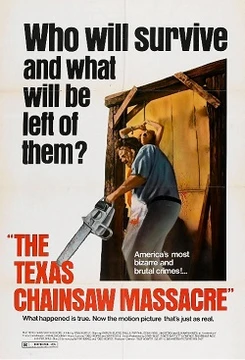
The Cook's Customers
They came for a fill-up. They became the special.
The Cook's Customers are the doomed souls who pull their dust-caked cars into the Sawyer family's remote gas station, lured by a promise of fuel and a friendly wave from the greasy old man behind the counter. These travelers—often young couples, lost families, or weary motorists—become unwitting ingredients in the family's cannibalistic meat trade. Their role in the Texas Chainsaw Massacre universe is that of prey, seduced by the illusion of roadside hospitality before being dispatched with a sledgehammer or chainsaw and processed into the Cook's infamous chili.
- Role
- Victims and prey
- Affiliation
- The Sawyer family (as targets)
- First appears
- The Texas Chainsaw Massacre (1974)
- Status
- Deceased (various)
Lore & Background
The Cook's Customers are a revolving cast of anonymous travelers who stop at the Sawyer family's remote gas station, a dilapidated outpost on a lonely Texas highway. The Cook, a greasy and seemingly harmless old man, engages them in conversation, often complaining about the heat or the price of gas, while sizing them up as potential victims. These customers are typically young people or couples, like the group of friends in the original film, who are simply trying to reach their destination. Their fate is sealed the moment they step inside, as the station doubles as a front for the family's cannibalistic enterprise.
Once lured into the adjacent farmhouse or the station's back rooms, these customers become the raw material for the Sawyers' meat trade. The family, including the hulking Leatherface and the sinister Hitchhiker, dispatches them with brutal efficiency, often using a sledgehammer or a chainsaw. The bodies are then processed in the kitchen, where the Cook's brother Drayton (the same character) prepares them as chili or other dishes, which are sometimes sold back to unsuspecting customers. This cycle of predation underscores the family's utter disregard for human life and their twisted self-sufficiency.
The customers themselves are never named or developed as characters, serving instead as archetypes of innocence and vulnerability. Their terror is palpable in the film's iconic scenes, such as the van's arrival and the frantic attempts to escape. The Cook's friendly demeanor masks a cold-blooded predator, making these encounters a chilling commentary on the dangers lurking in mundane settings. The customers' ultimate fate—to be butchered and consumed—cements the Sawyers' place in horror history as one of cinema's most terrifying families.
In Their Own Story
The dust-caked pickup rolled to a stop beside the rusted pump, its driver a young man with a sunburned arm hanging out the window. 'Fill 'er up?' he called to the old man shuffling out of the station's shadow. The Cook nodded, wiping his hands on a stained apron, his eyes scanning the truck's bed—a cooler, a duffel bag, a girl asleep in the passenger seat. 'Hot day for travelin',' he muttered, hooking the nozzle. 'Where you headed?' The driver smiled, unaware of the meat hooks glinting in the back room. Inside, the radio crackled static, and the smell of old grease hung thick. The Cook's grin never wavered as he watched the fuel tick over, counting not dollars, but pounds.
Reader's Guide
The Cook's Customers are not a formal faction but a category of victims in the Texas Chainsaw Massacre narrative. They are the unsuspecting individuals who stop at the Sawyer family's gas station, drawn by the need for fuel or directions. Their primary goal is survival, though they are unaware of the danger until it is too late. The members are typically young travelers, often in groups, such as the five friends in the 1974 film: Sally, Franklin, Jerry, Kirk, and Pam. They have no collective identity or leadership, as each group is isolated and unaware of the family's history.
Their role in the conflict is purely as prey, serving to highlight the Sawyers' predatory nature. The customers' interactions with the Cook are brief but pivotal, as his friendly demeanor lulls them into a false sense of security. Once inside the farmhouse, they face Leatherface's chainsaw and the Hitchhiker's sadistic games. Their deaths are swift and brutal, with no chance of negotiation or escape. This dynamic reinforces the Sawyers' dominance and the customers' helplessness, making them a key element in the franchise's horror. The customers have no allies or resources, and their story is one of tragic naivety in a world where trust is a death sentence.
Did You Know?
- The Cook's gas station was actually a real roadside location used for filming, adding to the gritty authenticity of the original movie.
- In the original film, the Cook's customers are never shown being butchered on-screen, leaving much to the imagination and heightening the horror.
- The character of the Cook was played by Jim Siedow, who also portrayed him in the sequel, making him one of the few Sawyer family members to appear in multiple films.
- The gas station's 'We Slaughter Barbecue' sign is a darkly ironic nod to the family's true business, though customers never catch on.
- In the 1974 film, the Cook's customers include a group of friends whose van breaks down—a breakdown that was actually staged by the Hitchhiker, who slashed their tire with a straight razor.
More in Factions & Groups
Elsewhere in the The Texas Chainsaw Massacre universe
Spotted an error? Know more?
This is a living reference — every entry is fact-audited, and reader corrections feed straight into our audit queue. Suggest an edit · See this site's audit record