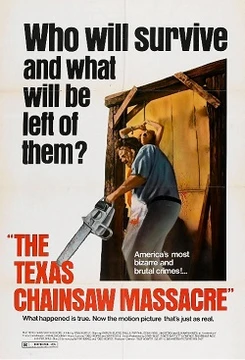
Leatherface (1974)
He doesn't want to hurt you; he just doesn't know how to do anything else.

Leatherface is the towering, silent antagonist of Tobe Hooper's 1974 horror landmark *The Texas Chain Saw Massacre*. A gaunt, lanky figure wrapped in a patchwork of what appears to be human skin and wielding a roaring chainsaw, he is the family's enforcer and, in a twisted domestic sense, its cook. He speaks almost never, communicating instead through guttural grunts, wet chewing, and the mechanical shriek of his blade.
Though he is the face of the franchise, the 1974 Leatherface is not a mastermind. He is a childlike, eager servant to his grotesque household, performing horrific tasks with a bewildered, almost apologetic energy. That contrast—innocent demeanor wrapped around unspeakable violence—makes him one of the most unsettling figures in cinema history.
- Role
- Primary antagonist / family enforcer
- First appears
- The Texas Chain Saw Massacre (1974)
- Portrayed by
- Gunnar Hansen
- Affiliation
- The family (Grandpa, Sissy, Papa)
- Signature weapon
- Chainsaw
- Fate in 1974 film
- Killed by his own family for failing to 'cook' the victims
Lore & Background
In the world of the 1974 film, Leatherface belongs to a feral, inbred family holed up in a rotting farmhouse deep in the Texas countryside. Grandpa, a wheezing old man chained to his wheelchair, is the matriarchal voice of the household. Sissy, a woman with a shattered nose, handles the domestic horrors. Papa, a silent, heavyset figure, is the butcher. Leatherface sits at the bottom of this hierarchy: he fetches, he kills, he feeds. When he fails—when the meat is wrong, when the victims escape his grip—the family turns on him with the same casual cruelty they show their prey.
The character's design is deliberately unglamorous. Gunnar Hansen, a real-life carpenter with no acting training, was cast for his raw, physical presence. The mask is not a sleek monster cowl but a lumpy, stitched-together face of skin that looks like it was assembled in a hurry. The chainsaw is a real, clanking, fuel-stained tool, not a prop. This grounded, almost documentary texture is what separates the 1974 Leatherface from later, more stylized iterations.
Culturally, the character drew a loose line to the real-life criminal Ed Gein, whose 1957 crimes in Wisconsin involved wearing a mask fashioned from human skin. Hooper and his collaborators used Gein as a starting point but pushed the mythology into something stranger: a family of cannibals who treat murder as a household chore and Leatherface as the one who keeps the saw sharp.
In Their Own Story
The heat hangs thick over the yard. The screen door bangs shut behind him, and the smell hits first—sweet, cloying, wrong. He stands in the doorway of the kitchen, saw idling at his hip, and looks at the thing on the table with the same expression a kid might give a broken toy. He grunts. Not angry. Confused. Like he's asking, *is this supposed to be enough?*
Sissy doesn't answer. She's already turning back to the stove. Grandpa creaks in his chair, wheezing a verdict. The old man's hand points at the saw. Then at the table. Then at Leatherface's chest.
The saw kicks back, spits a spray of oil. Leatherface flinches, tilts his head, and starts humming something tuneless. He doesn't understand why they're disappointed. He did what he was told. He just didn't do it the way they wanted.
The screen door bangs open again. The heat pours back in.
Reader's Guide
Leatherface (1974) is the original and, for many fans, definitive version of the franchise's most iconic killer. He appears in Tobe Hooper's *The Texas Chain Saw Massacre* (1974), where he serves as the family's physical enforcer and, in their warped domestic logic, their cook. He is portrayed by Gunnar Hansen, a carpenter with no prior acting experience, whose lanky frame and blank, almost childlike expression became inseparable from the role.
His relationships are strictly familial and hierarchical. Grandpa, the wheezing patriarch in his wheelchair, issues commands. Sissy, the noseless woman, manages the household's darker logistics. Papa, the silent butcher, handles the meat. Leatherface is the one who wields the saw, fetches the victims, and feeds the family. He is loyal, eager, and utterly without self-awareness. When he stumbles—when a victim escapes, when the meat is wrong—the family's patience evaporates.
His fate in the 1974 film is brutal and domestic: the family kills him for his failure, treating his death as a chore rather than a punishment. He is dismembered and consumed. There is no grand confrontation, no final monologue. Just a family going back to dinner.
What makes the 1974 Leatherface iconic is his *ordinariness*. He is not a demon or a madman in the theatrical sense. He is a guy in a skin mask who hums while he works, who looks genuinely confused when things go wrong. That gap between his gentle, almost shy manner and the absolute horror of what he does is the engine of the film's dread. He remains the benchmark against which every later iteration is measured.
Did You Know?
- Gunnar Hansen, who played Leatherface in 1974, was a carpenter with no acting background; he was cast largely for his physical presence and was given minimal direction on set.
- The 1974 film's actual on-screen title reads 'The Texas Chain Saw Massacre' with 'Chain Saw' as two words, a spelling that has been a point of trivia for fans for decades.
- The character is loosely inspired by the real-life criminal Ed Gein, whose 1957 crimes in Wisconsin included fashioning a mask from human skin, though the film's cannibal-family premise is entirely fictional.
- In the 1974 film, Leatherface is killed by his own family members after they judge his 'cooking' inadequate, making his death a domestic punishment rather than a heroic confrontation.
More in Characters
Elsewhere in the The Texas Chainsaw Massacre universe
Spotted an error? Know more?
This is a living reference — every entry is fact-audited, and reader corrections feed straight into our audit queue. Suggest an edit · See this site's audit record