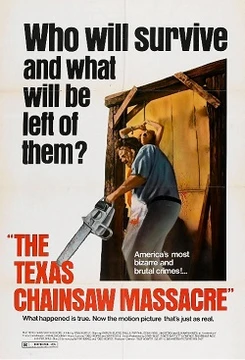
The Cook
He doesn't swing the saw—he just makes sure nothing goes to waste.

The Cook is a masked member of the Saw family, the grotesque kin who haunt the decaying farmhouse at the edge of the Texas backroads. His domain is the kitchen—a room that smells of rendered fat and old blood—where he tends to the family's "meat" with the quiet, methodical patience of a long-practiced trade. He is not the one who wields the saw; he is the one who makes the harvest usable, the quiet engine behind the family's grim economy.
Across the franchise's iterations, the Cook serves as a reminder that the Saw family is not a single monster but a household. He stands among the matriarch, the wheelchair-bound sister, and Leatherface himself, each bound by a code older than any of them, each playing a role that keeps the household's terrible routine turning.
- Character
- The Cook
- Role
- Family cook / meat preparer
- Affiliation
- The Saw Family
- First appears
- The Texas Chain Saw Massacre (1974)
- Status
- Deceased (presumed)
- Distinguishing feature
- Face mask fashioned from human skin
Lore & Background
The Cook occupies a place in the Saw household that is, in its own twisted logic, almost domestic. While Leatherface is the family's blunt instrument and the matriarch is its voice, the Cook is its hands in the most literal sense. He moves through the kitchen with a calm that is somehow worse than any snarl, treating the preparation of flesh the way a rural cook treats a Sunday roast: with care, with repetition, with an almost tender familiarity. The face mask he wears—stitched, stretched, and set over his features like a second skin—serves both as concealment and as a kind of uniform, marking him as one of the family's masked workers.
The family's code, as the Cook embodies it, is one of absolute self-sufficiency. Nothing is wasted. Outsiders who stumble onto the property are not merely killed; they are incorporated into the household's cycle, becoming fuel, becoming food, becoming part of the routine that has sustained this family through generations of isolation and madness. The Cook does not question this. He does not need to. The matriarch's word is law, the sister's presence is a constant reminder of the family's fragile, decaying body, and Leatherface's saw is the final argument. The Cook simply does his work, wipes his hands, and waits for the next delivery.
What makes the Cook unsettling in a way that even Leatherface is not is his ordinariness. There is no rage in his movements, no performative violence. He is a man doing a job in a kitchen, and that quiet normalcy perched atop an atrocity is what makes the image stick in a viewer's mind long after the credits roll.
In Their Own Story
The kitchen light hums its single yellow note. The Cook stands at the steel table, apron dark with old stains he will never wash out, and works the blade through the meat with the slow, patient rhythm of a man who has done this ten thousand times. Outside, the wind drags dead leaves across the yard. The matriarch's voice comes from the dark of the hallway, low and dry as a match striking: "He's still breathing, boy. Finish what you started." The Cook does not turn. He does not need to. He adjusts his grip, tilts the mask so the light catches the stretched skin over his jaw, and goes back to work. The saw will do its part later. The Cook only has to make sure the rest is done right.
Reader's Guide
The Saw family is not a crew or a gang. It is a household, and its horror comes from the domesticity of its dysfunction. The matriarch speaks; the others obey. She is the face to the world, the one who greets the outsiders at the door with a smile that never quite reaches the eyes. The sister, bound to her wheelchair, is the family's conscience and its wound—present, suffering, and never quite allowed to leave. Leatherface is the muscle, the blunt end, the one who answers when the matriarch says the word that means *go*. And the Cook is the hands in the kitchen, the one who keeps the cycle turning so the family can eat, can sustain, can keep the lights on in that rotting house.
They move as a unit. No single member acts alone. The matriarch directs, Leatherface enforces, the sister witnesses, and the Cook processes. Outsiders who stumble onto the property are not hunted by one killer; they are absorbed by a system. The family's code is simple and absolute: nothing enters the household that does not leave as part of the household. The land is theirs. The house is theirs. And everyone who crosses the fence becomes, in the family's grammar, an ingredient.
Their dysfunction is the engine. The matriarch's dementia sharpens into command. The sister's pain sharpens into silence. Leatherface's confusion sharpens into obedience. The Cook's routine sharpens into ritual. None of them are fully in control of themselves, and that is precisely why the machine keeps running. The horror is not that they are monsters. The horror is that they are a family, and the family is the thing that cannot be argued with.
Did You Know?
- The Cook's face mask, like those worn by other Saw family members, is implied to be constructed from human skin, a detail that has become one of the franchise's most iconic visual motifs.
- In the 1974 original, the family's activities are largely implied through sound and suggestion rather than explicit on-screen violence, a choice driven by the era's censorship constraints that paradoxically made the horr
- The Cook is never given a personal name in the franchise; he is identified solely by his function within the household, reinforcing the family's tendency to reduce individuals to roles.
- The kitchen in which the Cook operates is one of the most frequently referenced locations in the series, serving as a recurring symbol of the family's self-sustaining, closed-loop existence.
More in The Saw Family
Elsewhere in the The Texas Chainsaw Massacre universe
Spotted an error? Know more?
This is a living reference — every entry is fact-audited, and reader corrections feed straight into our audit queue. Suggest an edit · See this site's audit record