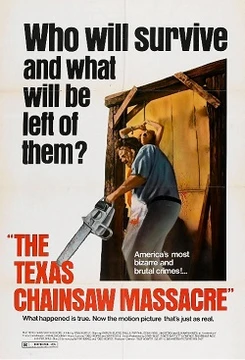
Leatherface's Chainsaw
The roar of death in the Texas heat—a mechanical scream that turns the air to panic.
Leatherface's chainsaw is the iconic weapon and tool of the cannibalistic Sawyer family, most famously wielded by the hulking, mask-wearing Leatherface. More than just a killing implement, the chainsaw represents the family's brutal, industrial approach to survival and their twisted version of domestic life in rural Texas. Its roar is a signature sound of terror in horror cinema, signaling the relentless pursuit of victims through the family's decaying farmhouse and surrounding fields.
- Role
- Primary weapon and tool for Leatherface
- Affiliation
- Sawyer family
- First appears
- The Texas Chain Saw Massacre (1974)
- Status
- Active throughout the original film and its sequels
Lore & Background
The chainsaw used by Leatherface is a gas-powered, single-person saw, likely a model from the 1960s or early 1970s, reflecting the family's preference for heavy, durable machinery. It is not merely a weapon but an extension of Leatherface himself—his primary means of asserting dominance, dispatching victims, and even performing household tasks like cutting wood. The saw's engine sputters and screams, creating a distinctive auditory signature that precedes his attacks.
In the world of the film, the chainsaw embodies the Sawyers' rejection of modern society and their embrace of a brutal, self-sufficient lifestyle. It is kept in the family's workshop, alongside other tools of their trade, and is often stained with the blood of their victims. Leatherface treats the saw with a kind of reverence, revving it menacingly before each assault, as if it were a living thing that shares his rage.
The chainsaw's design—with its exposed chain, metal bar, and lack of safety features—mirrors the family's raw, unpolished violence. It is a tool of the slaughterhouse repurposed for human prey, linking Leatherface to his role as the family's butcher and enforcer. Its constant noise also serves to disorient victims and mask the sounds of their screams, making it an effective instrument of terror.
In Their Own Story
The sun was a white-hot coin in the Texas sky, but inside the Sawyer house, the air was thick with the smell of rust and old meat. Bubba, as the family called him, stood in the workshop, his apron stained dark. He reached for the chainsaw hanging on the wall, its metal warm from the afternoon heat. He pulled the cord once, twice—the engine coughed, then roared to life, a deafening snarl that shook the dust from the rafters. The chain spun, a blur of teeth. He held it up, feeling its vibration travel through his arms, into his bones. Outside, a car door slammed. Footsteps on gravel. A voice, laughing. Bubba's eyes, behind the mask of dried skin, went wide. He stepped into the doorway, the saw held high, and the laughter stopped—replaced by a shriek that the engine swallowed whole.
Reader's Guide
Leatherface's chainsaw is a gas-powered cutting tool used both for practical purposes and as a weapon. In-world, it functions like any standard chainsaw: the user pulls a starter cord to ignite the engine, which drives a chain around a metal guide bar. The chain's teeth are designed to cut through wood, but against flesh and bone, they are devastatingly effective.
Leatherface wields the saw with one or two hands, often swinging it in wide arcs to intimidate or dismember. He uses it to break down doors, clear obstacles, and, most famously, to pursue victims through the family's property. The saw's noise is a key tactical element—it announces his presence, creating panic, but also masks his own movements. He is known to rev the engine to heighten fear before striking.
The weapon is kept in the family's workshop, maintained with the same crude care as their other tools. It is not a precision instrument; it is a brute-force device that reflects Leatherface's own strength and lack of subtlety. The saw's fuel and chain oil must be replenished, but the family's scavenging lifestyle ensures a steady supply. For victims, the only defense is to outrun or outsmart its wielder, as the saw's reach and power make direct confrontation nearly impossible.
Did You Know?
- The chainsaw used in the original 1974 film was a real, functioning saw, and actor Gunnar Hansen had to be careful not to injure the cast during chase scenes.
- The sound of the chainsaw was often recorded separately and added in post-production to ensure it was loud and menacing enough.
- In the film's climax, the chainsaw is used to cut through a metal door, though real chainsaws of that era would have struggled with such a task.
- The chainsaw's design in the original film was intentionally left unmodified to look like a standard, everyday tool, emphasizing its realism.
Frequently Asked Questions
Who wields Leatherface's Chainsaw?
The chainsaw is the signature weapon of Leatherface, the towering, mask-wearing member of the Sawyer family. It serves as both his primary killing instrument and a tool for the family's grim, industrial routines in their rural Texas homestead.
What is Leatherface's Chainsaw's role in the franchise?
Beyond being a murder weapon, the chainsaw embodies the Sawyer family's twisted domesticity—it is how they process, hunt, and maintain their isolated way of life. Its constant roar functions as the audience's auditory warning that Leatherface is closing in on a victim.
When did Leatherface's Chainsaw first appear on screen?
It debuted in Tobe Hooper's 1974 original, The Texas Chain Saw Massacre, where it became the film's most recognizable prop. The weapon has remained in active use across the franchise's sequels and reboots ever since.
Why is Leatherface's Chainsaw considered one of horror's most iconic props?
Its combination of relentless mechanical noise, crude industrial design, and the unstoppable chase it enables made it a shorthand for inescapable dread in 1970s cinema. The sound alone—revving, snarling, tearing through air—has become a cultural shorthand for terror that predates any visual.
Does Leatherface's Chainsaw get destroyed or retired at the end of the story?
No; the chainsaw remains in active service throughout the original 1974 film and carries over into the sequels as a continuing tool of the Sawyer household. It is never shown being scrapped or replaced, reinforcing its status as a permanent fixture of the family's operations.
More in Powers & Artifacts
Elsewhere in the The Texas Chainsaw Massacre universe
Spotted an error? Know more?
This is a living reference — every entry is fact-audited, and reader corrections feed straight into our audit queue. Suggest an edit · See this site's audit record