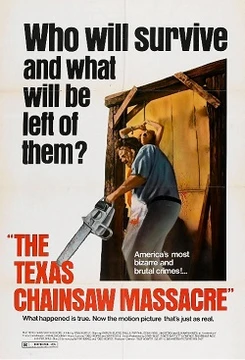
The Stalker
He cannot see you, but he has already found you.

The Stalker is one of the most unsettling figures in the Sawyer family's grotesque household: a young, blind, and mute boy who moves through the family's world like a silent shadow. He is not the butcher, not the matriarch, not the face that greets outsiders at the door—he is the thing that follows, the small pair of unseeing eyes tracking movement through dust and dark. His presence turns the family's horror from a single monster into an ecosystem of dread, because the child is no less dangerous for being small, no less hungry for being quiet.
Across the franchise's appearances, The Stalker functions as Leatherface's constant companion, a pale echo of the larger man's violence stripped of speech and sight but amplified by instinct. He is the family's reminder that the cannibal tradition is not one generation's aberration but a lineage, passed down to children who learn to hunt before they learn to talk.
- Character
- The Stalker
- Role
- Silent stalker; companion to Leatherface
- Affiliation
- Sawyer Family
- First appears
- The Texas Chainsaw Massacre (1974)
- Physical traits
- Young child; blind; mute
- Status
- Deceased
Lore & Background
In the Sawyer household, every member has a function, and The Stalker's is the most patient one. Where Leatherface is the instrument of the kill and the family matriarch is the architect of the meal, the boy is the tracker. He moves through the property and the surrounding scrubland with a kind of animal awareness, sensing heat and motion through means other than sight. His muteness is not a limitation but a feature: he gives no warning, makes no sound, and the family's victims often do not realize a second set of eyes—blind, unblinking, hungry—has been watching them from the treeline.
His bond to Leatherface is the emotional core of the family's dysfunction. The two move in tandem, the boy trailing the larger man's footsteps, and their pairing suggests a kind of grotesque mentorship. The Stalker does not speak, does not question, does not flinch. He simply follows, simply waits, simply strikes when the moment arrives. In a family where roles are rigid and cruelty is domestic, the child's unquestioning obedience is perhaps the most chilling detail of all.
The Stalker's blindness is never explained as a medical condition in any clinical sense; it is simply part of his nature, as natural to him as Leatherface's mask. The family does not treat his disability as a deficiency. In their world, seeing is a liability, and the boy's unseeing eyes are a gift. He feels the world through sound, through the vibration of footsteps in dry earth, through the warmth of living flesh at close range. He is, in the family's logic, the perfect predator.
In Their Own Story
The afternoon sun bakes the dirt road white, and the flies have gone quiet, which is worse. The boy sits at the edge of the porch, bare feet flat on the warped boards, his head tilted at an angle that suggests he is listening to something no one else can hear. His eyes are open, glassy, fixed on nothing. A cicada drones. A crow lands three yards away and does not flee, as if it, too, has learned that the small blind thing on the porch is not the one to worry about. Behind him, in the kitchen, a knife scrapes against a plate. The boy does not turn. He does not need to. He tilts his head a fraction more, and his thin fingers curl against the wood. Somewhere out in the brush, a branch snaps. He smiles. He has not smiled in a long time. The crow takes off. The boy stands, and his bare feet find the steps without looking, and he walks into the heat with the unhurried patience of something that has all the time in the world and intends to use every second of it.
Reader's Guide
The Sawyer family is not a household so much as a functioning unit of predation, each member a specialized organ in a single monstrous body. The matriarch sets the table and decides who eats. The father-figure enforces the code and keeps the machinery running. Leatherface is the hands, the mask, the face the world remembers. The Stalker is the sense organ—the blind, mute child who tracks, who waits, who ensures nothing in the family's territory moves without being noticed. Together they form a closed loop: the land feeds them, they feed on the land's visitors, and the children learn the rhythm before they can form a word. Outsiders do not see a family; they see a trap, and the trap has a child at its center who does not need to see the spring to know when it will snap.
The Stalker, specifically, occupies the lowest rung of the hierarchy and the highest rung of dread. He is the youngest, the smallest, the one who speaks least. Yet he is the one who follows Leatherface into the field, the one whose small hands learn the weight of a tool before the weight of a book. He is the family's future, and that is what makes him unbearable to witness. In the collective portrait, he is the silence between the screams, the pause before the second blow, the reason the horror does not end when the big man falls. The family's dysfunction is not a flaw; it is the engine. The Stalker is the spark plug.
Did You Know?
- The Stalker's muteness and blindness are presented not as disabilities to be pitied but as functional advantages within the family's predatory code—he tracks by sound and heat, giving him an uncanny awareness of movement
- His constant physical proximity to Leatherface, trailing just a step or two behind, visually reinforces the idea that the family's violence is inherited and normalized from childhood.
- The Stalker appears in both the 1974 original and the 1986 sequel, making him one of the few family members to recur across entries and anchoring the family as a persistent, generational threat rather than a one-time eve
- In the 1974 film, his small stature and childlike appearance create a deliberate contrast with the violence he is complicit in, making the audience's instinct to protect him a trap the narrative exploits.
More in The Saw Family
Elsewhere in the The Texas Chainsaw Massacre universe
Spotted an error? Know more?
This is a living reference — every entry is fact-audited, and reader corrections feed straight into our audit queue. Suggest an edit · See this site's audit record