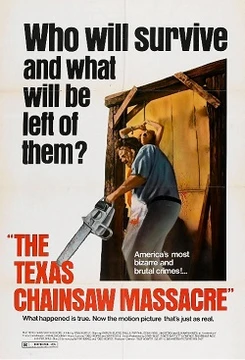
The Texas Chain Saw Massacre (1974)
A family, a chainsaw, and a Texas night that swallowed the light.

The Texas Chain Saw Massacre (1974) is the original film in the franchise, directed by Tobe Hooper and released in the mid-1970s. It follows a small group of young people whose detour to a family grave in rural Texas leads them into the clutches of the Sawyer family, a group of cannibalistic relatives whose most prominent member is the towering, mask-wearing Leatherface. The film is celebrated for its raw, almost documentary-like aesthetic, its unflinching violence, and its deeply unsettling atmosphere of slow-burn dread.
As the foundational text of the entire franchise, it established the core mythology—the derelict farmhouse, the chainsaw, the family of degenerates, and the sense of inescapable rural horror—that every subsequent entry, prequel, and reboot has referenced, expanded, or reimagined. It remains a landmark of independent horror filmmaking and a cultural touchstone for the slasher genre.
- Director
- Tobe Hooper
- Release Year
- 1974
- Setting
- Rural Texas
- Lead (Leatherface)
- Gunnar Hansen
- Lead (Sally)
- Marilyn Burns
- Genre
- Horror / Slasher
- Production Style
- Extremely low-budget independent film
Lore & Background
The 1974 film presents the Sawyer family not as a single monster but as a household of degeneration. The matriarch, a grotesque old woman, presides over a squalid farmhouse where the family prepares and consumes human flesh with the casual domesticity of a Sunday dinner. The 'Uncle,' a hunched figure with a hook, and the towering Leatherface—wrapped in a mask of stitched human skin and wielding a chainsaw—complete a family unit bound by madness, isolation, and a twisted sense of kinship. Their world is one of rotting meat, rusted tools, and a landscape of red dirt and heat that feels less like a place and more like a fever dream.
What makes the film's lore endure is its ambiguity. The Sawyer family's backstory is never fully explained; they are simply *there*, a festering presence in the Texas hinterland. Their motivations are not malice in a calculated sense but something older and more primal—a hunger, a need to consume, a family ritual so deeply embedded that it reads as normalcy. This lack of tidy explanation has allowed decades of fan interpretation, prequel, and sequel to layer new mythologies atop the original without ever fully resolving it.
Culturally, the film sits at the intersection of New Hollywood's gritty realism and the emerging slasher wave. Its handheld camera work, natural lighting, and minimal score (a single, dissonant organ piece) create a sense of immediacy that made audiences feel they were witnessing something real. This aesthetic choice, born partly of budget constraints, became the film's greatest strength and a touchstone for independent horror to come.
In Their Own Story
The truck sputters to a stop on a stretch of red dirt road where the trees thin out and the heat shimmers off the earth like a mirage. Sally rolls down the window and breathes in the smell—pennyroyal, dry clay, something faintly sweet underneath. Franklin points toward the headstone half-swallowed by scrub grass. 'Just a quick look,' he says, and the words already sound like a promise they won't keep.
They walk. The farmhouse appears the way a wound appears—slowly, then all at once, its white paint peeling in long strips, the porch sagging under the weight of years. A woman's voice drifts from the doorway, humming something old. The screen door creaks. The light inside is amber and thick, and the air tastes of iron.
Sally's fingers find the back of her neck. Franklin is already stepping forward. And somewhere behind the wall, in a room that shouldn't exist in a house this small, something heavy shifts on its feet and the floorboards groan in answer.
Reader's Guide
The Texas Chain Saw Massacre (1974) is the original and foundational entry in the franchise. Directed by Tobe Hooper, it follows Sally, her boyfriend Franklin, and a friend who detour to a family grave in rural Texas and are lured to a derelict farmhouse inhabited by the Sawyer family—cannibalistic relatives led by the towering, mask-wearing Leatherface. What begins as a macabre curiosity spirals into a desperate, violent fight for survival.
In the shared franchise timeline, this is the anchor event. The 2003 film (later retitled The Texas Chainsaw Massacre: The Beginning) functions as a prequel, exploring the family's earlier degeneration. The 1986 sequel extends the story forward. The 2022 reboot reimagines the core premise with a new cast and updated setting while preserving the essential structure: outsiders arrive, the family consumes, escape becomes nearly impossible.
Key plot beats include the group's arrival at the grave, the encounter with the old woman and the 'Uncle,' the horrifying discovery of the family's true nature, the desperate escape attempts, and the film's infamous final act. The raw, almost documentary quality—achieved through limited resources and handheld camera work—gives it a visceral dread that later, more polished entries rarely replicate.
Timeline placement: Events occur in the mid-1970s in rural Texas. Contradictions arise across sequels and prequels regarding the family's exact history, the number of family members, and the fates of specific characters, as each entry was produced in a different era by different creative teams.
Did You Know?
- The film was produced on an extremely low budget, with much of the set and practical effects built by the crew themselves, which contributed to its raw, unpolished visual texture.
- Gunnar Hansen, who portrayed Leatherface, was a complete unknown before the film and had no prior acting experience; his physical presence and the mask made the role iconic almost overnight.
- The film's single, dissonant musical score was performed on a church organ, a choice that became one of the most recognizable sounds in horror cinema.
- Tobe Hooper was a student filmmaker at the time, and the project was largely a student/indie production that went on to influence the entire slasher subgenre.
More in Films & Timeline
Elsewhere in the The Texas Chainsaw Massacre universe
Spotted an error? Know more?
This is a living reference — every entry is fact-audited, and reader corrections feed straight into our audit queue. Suggest an edit · See this site's audit record