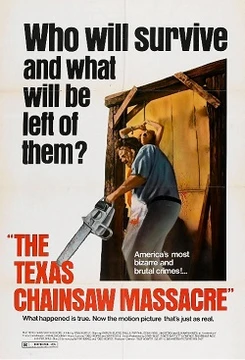
The Small Town
Where the highway ends, the law thins, and the heat does the rest.

The Small Town is the dusty, sun-bleached rural Texas backdrop that anchors the Texas Chainsaw Massacre franchise. It is not a bustling community but a thin scattering of structures—gas stations, a general store, a church, a sheriff's office—strung along a two-lane highway through red-dirt farmland. For the handful of townsfolk who remain, it is home; for the travelers who pass through, it is a place where the rules of the outside world quietly dissolve.
Its role in the story is that of a pressure chamber. The town's poverty, isolation, and social decay create the conditions under which the Sawyer family can operate with near-total impunity. The environment does not merely host the horror; it feeds it. Heat, distance from help, and a population too small and too afraid to ask questions turn the landscape itself into an accomplice.
- Location
- Rural Texas (unspecified county)
- First appears
- The Texas Chain Saw Massacre (1974)
- Role
- Primary setting and atmospheric backdrop for the franchise
- Key residents
- Sawyer family (Leatherface, the Grandmother, the Drifter)
- Status
- Ongoing setting across the 1974, 2003, and 2022 film entries
- Defining trait
- Extreme isolation and economic decay
Lore & Background
In the 1974 original, the town is revealed in fragments: a gas station where a character tops off the tank, a storefront with faded signage, a church steeple visible from the road. Tobe Hooper never lingers. The camera skims the architecture the way a hand skims a bruise—just enough to register that this is a place where things have been falling apart for decades. The Sawyers' farmhouse sits a short drive from this cluster of buildings, but the geography feels deliberately vague, as if the town is less a fixed point on a map and more a psychological threshold. Cross the last stretch of dirt road and you are no longer in a community with a mayor and a water bill. You are in country where the nearest neighbor might be a mile away and the nearest hospital might be an hour.
The 2003 remake expands the town's visual vocabulary somewhat, giving it a slightly more populated feel with additional background characters and a more defined commercial strip, yet the underlying logic remains: this is a place where people look away. The 2022 entry leans harder into the post-industrial decay, with more boarded-up structures and a stronger sense that the town is in active terminal decline. Across all three, the town functions as a warning label. The characters who ignore it—who stop for gas, who take a shortcut, who trust the quiet—pay for that trust in the most visceral way the franchise knows how.
What makes the Small Town work as a horror setting is its ordinariness. There is no gothic castle, no haunted mansion. There is a peeling paint job, a rusted pickup in a driveway, a screen door that sticks. The dread comes from the fact that this is a real kind of place, a kind of place that still exists in the American South, where a family with a chainsaw and a reason to be angry can simply… be. And nobody comes to check.
In Their Own Story
The radio in the car dies at mile marker forty-three. That's when the heat really gets in, thick and sweet, the kind that makes the dashboard plastic feel like it's breathing. You pull over because the engine is ticking and the gas needle is in the red, and the station ahead looks like it's been waiting for a customer since the Carter administration. The attendant doesn't come out. A hand-painted sign reads OPEN, though the word is half-peeled off the glass. You walk the gravel lot, and the air smells like cut grass and something older, something mineral. Behind the station, a dirt road forks off into a stand of cypress trees so dense the sky turns the color of a bruise. You tell yourself it's a shortcut. You tell yourself a lot of things before the screen door slams.
By the time you understand, the town is already behind you. The highway is already gone. There is only the red dirt, the heat, and the sound of something breathing through a mask.
Reader's Guide
You arrive by a two-lane highway that seems to materialize out of flat cotton fields. The town itself is a loose string of single-story buildings—a gas station with a cracked canopy, a hardware store with a corrugated-metal awning, a church with a steeple that leans slightly east. The paint on everything is faded to a uniform cream. There are no billboards, no chain stores. A few pickup trucks sit in driveways with rust bleeding down the fenders. The red dirt road that leads away from the commercial strip into the tree line is where the town's official end begins and the Sawyer property's unofficial jurisdiction starts.
The architecture is 1950s-and-earlier vernacular: wood-frame construction, cinder block, tin roofing. Screen doors. Porches with sagging steps. Inside the general store, the shelves are half-empty, the register is a mechanical bell-model, and the back room smells of kerosene and old meat. Nothing is locked. That is the point. Nobody locks anything here.
The environment amplifies dread through sensory overload: the relentless heat pressing against your skin, the dry crackle of dead grass underfoot, the way the cypress canopy swallows the sky and turns midday into a dim, greenish twilight. Sound carries weirdly in the still air—a distant engine, a dog barking, then nothing. The isolation is total. There is no cell signal. The nearest town with a hospital is an hour away, if the road hasn't washed out.
Across the franchise the town shifts subtly. The 1974 original is sparse and almost abstract, a suggestion of community. The 2003 remake adds a few more background figures and a slightly fuller commercial strip. The 2022 entry pushes the decay further: more boarded windows, more weeds cracking the asphalt, a stronger sense that the population is in active, quiet exodus. In all three, the town is a threshold. You cross it, and the social contract dissolves.
Did You Know?
- The 1974 original deliberately never names the town on screen, reinforcing the sense that it could be any number of forgotten rural communities across the American South.
- The Sawyer farmhouse is set just far enough from the town's commercial strip that the characters can drive past the last building and be in a zone with no witnesses, no traffic, and no one to call for help.
- The gas station appears in multiple entries as the last 'civilized' stop before the characters enter the Sawyer family's territory, functioning as a narrative checkpoint between the world of rules and the world without t
- The franchise's rural Texas setting was a deliberate contrast to the urban horror of many contemporary films, positioning the horror as something domestic, agricultural, and deeply rooted in the land itself.
More in World & Setting
Elsewhere in the The Texas Chainsaw Massacre universe
Spotted an error? Know more?
This is a living reference — every entry is fact-audited, and reader corrections feed straight into our audit queue. Suggest an edit · See this site's audit record