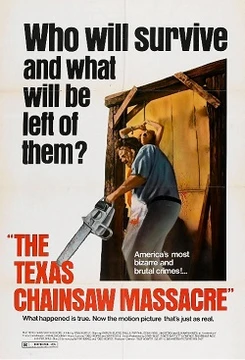
Leatherface
A child's devotion wrapped in a giant's body, armed with a saw and a stitched-on smile.

Leatherface is the towering, masked enforcer of the Saw Family and the most recognizable figure in the entire Texas Chainsaw Massacre franchise. A gaunt, lanky man who moves with a slow, grinding menace, he is the family's weapon made flesh—the one who steps into the yard, raises the saw, and turns the world's assumptions about hospitality inside out. He wears a mask stitched from human skin, and behind it, his expression is often something closer to a child's confused grin than a killer's rage.
His role is not that of a mastermind but of an instrument: the hands and the sound of a family whose will is set elsewhere. He is the face outsiders see, the noise they hear, the thing that chases them through the dark. And yet, across the films, he is also the most pitiable figure in the house—a giant perpetually waiting for a nod of approval that never comes, whose loyalty is the only currency he has and the only thing that keeps him from dissolving entirely.
- Character
- Leatherface
- Role
- Primary antagonist / family enforcer
- Affiliation
- The Saw Family
- First appears
- The Texas Chainsaw Massacre (1974)
- Signature weapon
- Chainsaw
- Status
- Varies by continuity (killed in the 1974 original's ending; alive in later sequels and reboots)
Lore & Background
The Saw Family squats on a stretch of rural Texas so overgrown and forgotten that it might as well be another country. There are no neighbors, no mail, no electricity that works more than an evening. The house is a crooked, rotting structure held together by nails and stubbornness, and the family's only economy is the flesh of anyone foolish enough to wander off the road. Their code is simple and absolute: the land is theirs, the house is theirs, and the people who come to it belong to them now. There is no negotiation, no apology, no after. Just the slow, wet business of making the outsider part of the inventory.
Leatherface occupies the most visible position in that hierarchy, which makes him the most vulnerable. He is the one who must go outside, who must make the noise, who must be the thing that frightens. The Mother dictates; the Uncle enforces; Leatherface executes. His masks—each one a patchwork of different faces—serve a practical purpose as much as a symbolic one: they keep the family's identity hidden, turning him into a generic, interchangeable horror rather than a person. In many tellings, his demeanor is almost boyish. He fidgets, he stares, he seems to want to be told he did a good job. The horror is not that he is a monster. The horror is that he is a man who has been shaped, over years of isolation and abuse, into a function.
Across the franchise, his portrayal shifts but the core remains: he is the family's face, and the face is a mask. Remove it, and there is only a hungry, confused young man in a room full of people who will never call him by a name that isn't a job description.
In Their Own Story
The screen door groans open and the smell hits first—grease, old blood, the sweet rot of something left too long in a warm room. He stands in the yard with the saw idling at his hip, the vibration humming up through his boots and into his teeth. His mask is a different one today. He likes this one. The smile is wider. The eyes are smaller. He tilts his head the way a dog tilts its, listening for the sound of the car engine, the sound of the footsteps on gravel, the sound of the voice that will say *please* in a way that makes his chest tighten with something he has no name for.
Inside, the house is dark except for the glow of a single bare bulb over the kitchen table. The Mother is stirring something in a pot. The Uncle is sharpening a knife with a slow, rhythmic scrape. Neither of them looks up. Leatherface watches the driveway. The headlights are coming around the bend. He grips the saw a little tighter. He does not know why he is afraid. He knows only that the family is waiting, and that waiting is the one thing he cannot do.
Reader's Guide
The Saw Family operates less like a household and more like a feudal court carved from rotting wood and grease. They are bound by a single, unspoken covenant: the land belongs to them, and anyone who trespasses becomes part of the land. There is no law, no neighbor, no authority—only the family's word, delivered in a dialect that blurs into growl.
At the top sits the Mother, the matriarch whose slow, deliberate commands set every action in motion. Below her, the Uncle enforces her will with blunt, physical authority; he is the family's conscience and its cruelty in equal measure. Leatherface is the face, the hands, the sound. He is the one who steps outside, who raises the saw, who wears the mask so that the family's identity stays hidden behind a grinning, stitched-together smile. His loyalty is absolute, his understanding of the world is narrow, and his devotion to the family is the engine that drives the horror forward.
Individually, each member is a wound. The Mother is a slow poison. The Uncle is a closed fist. Leatherface is a child locked in a giant's body, perpetually hungry for approval he will never receive. Together, they are a machine that grinds outsiders into meat and memory, and the land they squat on is the only witness. Their dysfunction is not a flaw in the horror—it IS the horror.
Did You Know?
- In the 1974 original, Leatherface is killed at the film's conclusion, yet he returns alive as the central antagonist in the 1986 sequel, establishing the family's resilience as a recurring theme.
- His masks are typically depicted as patchwork constructions assembled from the skin of multiple different individuals, making each one a composite rather than a single face.
- Across multiple films, Leatherface is characterized not as a calculating killer but as a loyal, almost childlike figure whose actions are driven by a desperate need for his family's approval.
- The 1974 original was directed by Tobe Hooper and became one of the most influential low-budget horror films of the 1970s, cementing Leatherface as a permanent fixture of the genre.
More in The Saw Family
Elsewhere in the The Texas Chainsaw Massacre universe
Spotted an error? Know more?
This is a living reference — every entry is fact-audited, and reader corrections feed straight into our audit queue. Suggest an edit · See this site's audit record