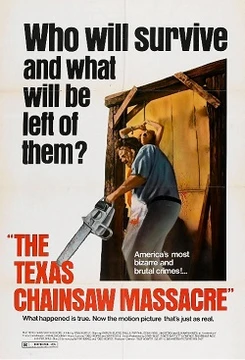
2003 Reboot
A family reunion in rural Texas where the only thing sharper than the blade is the silence.

The Texas Chainsaw Massacre (2003) is a direct-to-video horror film that reimagines the 1974 original for a new audience, stripping the story down to its core: a group of young friends stranded in rural Texas who stumble into the clutches of a deranged family and its masked butcher. Directed by Marcus Nispel and written by Scott Kosar, the film was produced by New Line Cinema and released straight to home video, positioning it as a self-contained reboot rather than a continuation of Tobe Hooper's landmark work.
Within the broader franchise timeline, the 2003 entry serves as a bridge between the cult legacy of the 1974 classic and the later 2006 prequel, The Texas Chainsaw Massacre: The Beginning. It re-established the core mythology—the family, the house, the chainsaw, the mask—for a 2000s audience while deliberately severing ties with the earlier sequels, allowing the story to breathe as a fresh, isolated nightmare.
- Title
- The Texas Chainsaw Massacre (2003)
- Director
- Marcus Nispel
- Screenplay
- Scott Kosar
- Release Year
- 2003
- Distribution
- Direct-to-video
- Studio
- New Line Cinema
- Role in Franchise
- Reboot / standalone reimagining of the 1974 original
Lore & Background
In the 2003 reimagining, the Leatherface family is presented as a grotesque, insular unit living in a decaying farmhouse deep in the Texas countryside. Their isolation is both literal and cultural: they exist outside the reach of law, commerce, or moral convention, sustained by a warped sense of familial duty. The patriarch's voice, muffled and distorted, commands the household with a bureaucratic calm that makes the surrounding horror feel all the more ordinary to them.
The family's relationship to their victims is framed less as mindless slaughter and more as a twisted hospitality. The house is set, the table is laid, and the guests are expected to appreciate the meal. This domestic framing—kitchen, dining room, the smell of cooking—transforms the horror from a simple chase into something deeply wrong, as though the audience is being invited to sit down and eat. The mask, the apron, the chainsaw: all are tools of the household, as mundane to Leatherface as a spatula is to a cook.
The 2003 version also leans harder into the psychological dread of the family's internal dynamics. Siblings bicker, the matriarch's presence looms through whispered commands, and the young woman in the house oscillates between curiosity and terror. This makes the family feel less like a collection of monsters and more like a dysfunctional household that has simply decided, collectively, that outsiders are food. The horror is domestic. The horror is familial. And that, in the Texas mythos, is the most terrifying thing of all.
In Their Own Story
The truck sputters to a dead stop on a stretch of two-lane road where the asphalt has given up and surrendered to cracked dirt. Sally steps out, boots crunching on gravel, and the air hits her thick and sweet—like overripe fruit left in the sun. Franklin kicks the tire, muttering. Behind them, the last gas station is a smear of yellow in the rearview, already a memory.
Then the house. It sits in a clearing like a wound in the tree line, clapboard siding peeling in long strips, a screen door hanging open on a hinge that groans in a wind nobody else can feel. A figure stands on the porch, backlit, too still. Too tall. The apron is stained in a pattern that could be rust, could be something else. He doesn't turn. He doesn't need to. Sally feels the weight of the gaze on the back of her neck like a hand, slow and deliberate, pressing.
Franklin laughs. A short, nervous bark. "Probably a farmer."
The screen door swings wider. The smell rolls out in a wave—iron and sugar and something older, something that has been cooking for a very long time. And from the kitchen, a voice, muffled and warm, says: "Come in. Dinner's almost ready."
Nobody moves. The chainsaw idles somewhere inside, a low mechanical purr, patient as a cat on a windowsill. Waiting for the door to close.
Reader's Guide
The 2003 reboot represents a deliberate editorial choice: to return the Texas Chainsaw Massacre to its 1974 DNA by treating the family as a closed, almost anthropological unit rather than a string of set-pieces. Where the 1986 and 1990 sequels leaned into spectacle and franchise mythology, Nispel and Kosar strip the narrative back to a single location, a single night, and a single escalating dinner. The horror is spatial. The house is the monster.
This resonated with early-2000s audiences who had grown up on the direct-to-video boom and found comfort in horror that felt intimate, claustrophobic, and unapologetically grim. The film's pacing—slow, deliberate, almost unbearable in its silence—mirrored a cultural moment when audiences were fatigued by the jump-scare excess of the late '90s slasher wave. The 2003 entry asked viewers to sit in the discomfort, to let the dread accumulate like heat in a closed room.
The 2006 prequel, The Beginning, then inverted this approach. Where 2003 treated the family as an established, immovable force, The Beginning mythologized their origin, turning the domestic horror into a generational tragedy. The 2003 film's quiet, kitchen-table menace became a footnote in a larger saga. Yet for fans who prefer the story as a single, self-contained nightmare—a family, a house, a blade—the 2003 reboot remains the purest distillation of what makes the Texas mythos work.
Did You Know?
- The 2003 film was released direct-to-video rather than receiving a theatrical run, a distribution strategy that New Line Cinema used to test the franchise's viability before committing to a follow-up.
- The 2006 sequel, The Texas Chainsaw Massacre: The Beginning, was structured as a prequel to the 2003 film, effectively making the 2003 entry the 'present-day' anchor of that continuity.
- The 2003 reboot deliberately does not reference the 1974 original's characters or events, functioning as a standalone reimagining rather than a sequel or remake in the traditional sense.
- The film's single-location structure—confined largely to the family farmhouse and its immediate grounds—was a conscious departure from the multi-location chases of the 1986 and 1990 sequels.
More in Themes & Franchise History
Elsewhere in the The Texas Chainsaw Massacre universe
Spotted an error? Know more?
This is a living reference — every entry is fact-audited, and reader corrections feed straight into our audit queue. Suggest an edit · See this site's audit record