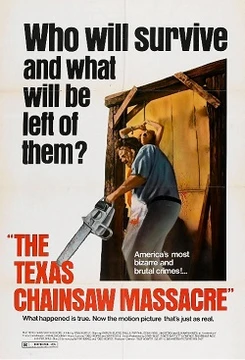
1974 Cult Shock Origins
A chainsaw, a family, and a house that never lets you leave.

The 1974 release of *The Texas Chainsaw Massacre* detonated a cultural shockwave that reshaped horror cinema almost overnight. Directed by Tobe Hooper and shot on a famously skeletal budget in the sweltering heat of rural Texas, the film arrived with a raw, almost documentary-like grit that audiences had never encountered in a theatrical horror picture. Its combination of unflinching practical violence, a deeply unsettling domestic setting, and the unforgettable silhouette of Leatherface turned a small independent production into an overnight legend and planted the seeds for the entire slasher genre that would follow.
For fans and filmmakers alike, the 1974 original remains the franchise's beating heart. Every subsequent entry—sequels, reboots, prequels—measures itself against the film's deliberate ugliness, its refusal to glamourize its monsters, and its insistence that the true horror lives in the banal, the familial, and the inescapable. Understanding where the franchise began is essential to understanding why it endures.
- Director
- Tobe Hooper
- Release Year
- 1974
- Leatherface (actor)
- Gunnar Hansen
- Sally Hardesty (actor)
- Marilyn Burns
- Initial US Rating
- X
- Setting
- Rural Texas
- Production Style
- Extremely low-budget, location-shot, practical effects
Lore & Background
The 1974 film's power lies in its deliberate refusal to polish. Shot in the thick Texas heat with a small crew and a cast that endured grueling, physically punishing schedules, the production conditions bled directly into the screen. The camera jitters and breathes. The sound design is rough, almost abrasive. The characters speak in clipped, panicked sentences rather than the measured dialogue of studio horror. This was not a mistake; it was the aesthetic. Hooper and his team leaned into the limitations and made them the point, creating a texture that felt less like a movie and more like a found nightmare.
The family at the center of the film—Pasty, the Cook, the Drifter, and of course Leatherface—were conceived as a grotesque distortion of Southern domesticity. They are not a gang of killers in a lair; they are a household. They cook, they argue, they take turns at the wheel. The horror is domestic, generational, and inescapable. Leatherface, for all his mask and saw, is played with a kind of bewildered, almost childlike confusion, which made him infinitely more terrifying than a purely malicious villain could have been. The audience is never given the comfort of a clear motive or a clean escape.
Culturally, the film landed in a moment when American cinema was still processing the social upheavals of the late 1960s and early 1970s. Its X rating, its unapologetic violence, and its suggestion that the threat could come from the most ordinary of places struck a nerve. It was banned or heavily cut in several countries, which only deepened its mythos. For a generation of viewers, it was the film that proved horror could be ugly, honest, and genuinely frightening without relying on spectacle.
In Their Own Story
The truck sputters on the dirt road, the engine coughing like a man clearing his throat after too much dust. Sally wipes the sweat from her forehead and watches the house through the windshield—lean, crooked, the porch sagging under its own weight like a broken jaw. The others are arguing in the back. She doesn't turn around. She can smell the meat before they round the bend, thick and sweet and wrong, hanging in the still air like a promise. The porch light is off. The screen door is open. And from somewhere deep inside the house, something is humming. Not a song. Just a low, steady, patient hum, like a machine that has been running for years and does not intend to stop. She grips the steering wheel. The road behind them is already gone, swallowed by the flat, endless Texas dark. There is no turning back. There was never a road to turn back on.
Reader's Guide
The 1974 original anchored the franchise in a specific cultural moment: post-Vietnam, post-Watergate America, where institutional trust had eroded and the horror of the ordinary became the most terrifying narrative available. Hooper's film channeled that anxiety through the figure of the family as a closed, inbred, predatory unit—a direct inversion of the nuclear ideal. The famous opening, with its documentary-style framing and the slow, agonizing discovery of the house, mirrors the era's distrust of media and authority. The violence is not stylized; it is messy, close-up, and physically exhausting to watch, reflecting a generation that had seen the real ugliness of war on television and expected their fiction to match it.
The X rating and the film's touring release strategy turned it into an event, a whispered legend passed between college students and drive-in patrons. This grassroots, word-of-mouth mythology became the template for how horror would be marketed for decades. Later entries, from the 1986 sequel to the 2003 remake and the 2022 reboot, each negotiated with this origin differently. The sequels leaned into spectacle and franchise mythology, trading the original's claustrophobic realism for broader set pieces. The remakes attempted to recapture the rawness for new audiences, sometimes succeeding, sometimes sanding down the very roughness that made the original work. What remains constant, and what fans return to again and again, is the 1974 film's core argument: that the scariest thing in the world is a family that will not stop, will not explain, and will not let you go.
Did You Know?
- Gunnar Hansen, who played Leatherface, was a former professional stuntman before this role, and his physicality and comfort with practical stunts shaped the character's iconic, lumbering presence.
- The film was shot on location in the Texas heat under extremely tight schedules, and the cast and crew have spoken in interviews about the grueling physical conditions that contributed to the film's raw, exhausted energy
- The initial X rating in the United States restricted theatrical access and paradoxically fueled the film's underground, touring-release cult following, making it an event you had to seek out rather than a picture you sim
- The film's deliberately rough, handheld cinematography and abrasive sound design were as much a product of its tiny budget as a creative choice, and that accidental grit became the franchise's most recognizable visual an
More in Themes & Franchise History
Elsewhere in the The Texas Chainsaw Massacre universe
Spotted an error? Know more?
This is a living reference — every entry is fact-audited, and reader corrections feed straight into our audit queue. Suggest an edit · See this site's audit record