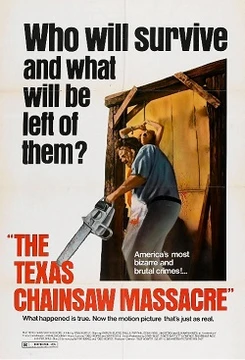
The Slaughterhouse Murders
A myth stitched together from later sequels and spin-offs.
The Slaughterhouse Murders are a later addition to the franchise's expanded lore, often retroactively applied to the Sawyer family's backstory. In the 1974 film, there is no reference to a named event or systematic operation called the 'Slaughterhouse Murders,' nor is an abandoned slaughterhouse depicted as the family's base. The family's cannibalism is implied to be for their own consumption, not for commercial sale, and the gas station barbecue being human meat is a later franchise invention.
- Role
- Retconned event in the Sawyer family lore
- Affiliation
- The Sawyer family (including Leatherface, Drayton, Nubbins, and Grandpa)
- First appears
- Later franchise materials; not referenced in the 1974 film
- Status
- Non-canon to the 1974 film
Lore & Background
The concept of the Slaughterhouse Murders was developed in later franchise entries, not in the original 1974 film. In that film, the Sawyer family's cannibalism is implied to be for their own consumption, not a systematic operation for commercial sale. The family's base is a rural farmhouse, not an abandoned slaughterhouse, and the gas station run by Drayton Sawyer does not sell human meat—the barbecue being human is a later addition. The family's murders are depicted as chaotic and opportunistic, not as a structured meatpacking operation.
In Their Own Story
The moon hung low over the rusted slaughterhouse, its hooks swaying in the wind like grim pendulums. Inside, the air was thick with the smell of blood and decay. A lone hitchhiker, unaware of the danger, approached the flickering light of the gas station. Drayton Sawyer greeted him with a warm smile, offering a ride. But the hitchhiker never made it home. In the slaughterhouse, Leatherface's chainsaw roared to life, its teeth sinking into flesh as Grandpa watched from his rocking chair, a faint smile on his lips. Another soul fed the family's insatiable hunger. The floor's drainage grates, still slick from the day's work, carried away the evidence in a slow, red trickle.
Reader's Guide
The Slaughterhouse Murders are a cornerstone of the Sawyer family's mythology, representing their descent into madness and cannibalism. These killings are not merely acts of violence but a twisted continuation of the family's butchering heritage. The abandoned slaughterhouse, with its hooks and conveyor belts, becomes a temple of horror where human life is reduced to meat. The murders are tied to the family's isolation and poverty, driving them to prey on the vulnerable. Key figures like Leatherface, with his chainsaw, and Grandpa, with his sledgehammer, embody the brutality of these acts. The murders also explain the family's disregard for human life, viewing victims as livestock. This lore deepens the terror of the franchise, showing that the Sawyers' evil is not born from a single event but from a legacy of slaughter passed down through generations. For fans, the slaughterhouse is the dark crucible where the family's identity was forged—a place where every scream was just another step in a butcher's dance.
Did You Know?
- The 1974 film does not feature an abandoned slaughterhouse; the family's home is a farmhouse with a workshop and a bone room.
- The gas station barbecue being human meat is a reveal from The Texas Chainsaw Massacre 2 (1986), not the original film.
- The 'Slaughterhouse Murders' as a named event is a retroactive creation from later franchise media, not present in the 1974 film.
- In the original film, the family's cannibalism is implied to be for their own survival, not for commercial sale.
More in Lore & History
Elsewhere in the The Texas Chainsaw Massacre universe
Spotted an error? Know more?
This is a living reference — every entry is fact-audited, and reader corrections feed straight into our audit queue. Suggest an edit · See this site's audit record