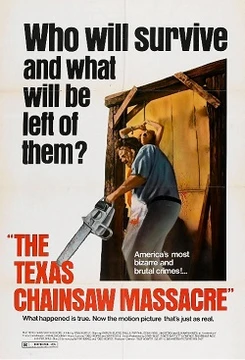
The Legend of Leatherface
The chainsaw-wielding face of rural American horror.
The Legend of Leatherface is the rotting, rusted heart of The Texas Chainsaw Massacre mythos—a name that doesn't just whisper terror but screams it through a curtain of buzzing steel and stale slaughterhouse air. This figure is no ghost or demon; he's a man twisted into something worse by a family that worships decay and a home that reeks of old blood. He is the family's butcher and enforcer, a silent, hulking giant who wears the faces of the dead and wields a chainsaw not as a weapon, but as an extension of his own broken will. He is the final, grinding note in the song of industrial rot and cannibal hunger.
- character
- Leatherface
- role
- Primary antagonist and family butcher
- affiliation
- The Sawyer family (also known as the Hewitt family in some continuities)
- first_appears
- The Texas Chain Saw Massacre (1974)
- status
- Active in various timelines and sequels
Lore & Background
Leatherface—born Thomas Brown or Bubba Sawyer, depending on which blood-soaked timeline you follow—is the most infamous member of a cannibal clan that feasts on lost travelers in the Texas backwoods. His name comes from the masks he wears: faces flayed from his victims, stitched into crude personas that mirror the shattered pieces of his mind. He is mentally a child trapped in a giant's body, driven by hunger, family orders, and a whimpering, grunting need to please. His chainsaw is no mere tool—it is a roaring, gasping beast that screams with him, a mechanical heart that beats for the kill, symbolizing how the modern world's machinery has been perverted into something primordial and hungry.
In Their Own Story
The dust of a dry Texas road clung to a rusted van as a group of friends stopped for gas. In the distance, a shape emerged from a crumbling farmhouse, his outline warped by the heat shimmer. He wore a mask of human skin—a dead woman's face stretched into a silent scream—and carried a chainsaw that coughed once, then roared to life. They never saw him move, only heard the metallic shriek and the wet thud of a heavy door slamming shut. Inside, the air was thick with the copper stench of old blood and the sweet rot of meat left too long. From the shadows came a sound like a child's whimper, swallowed by the growl of the saw.
Reader's Guide
The legend of Leatherface begins with Tobe Hooper's 1974 film The Texas Chain Saw Massacre, which injected horror with a needle of grit: no ghosts, no demons, just a family of butchers in a sun-scorched hell. Leatherface is the family's enforcer, tasked with dispatching victims and rendering their bodies into meals. His masks are not mere disguises—they are identities. A 'killing mask' for the hunt, a 'dinner mask' for the table, each one stitched from a different face, allowing him to shift personas like a child playing dress-up with the dead.
His chainsaw is more than a weapon; it is a snarling critique of industrial society, turning a machine of progress into a tool of primal terror. Across sequels and reboots, his backstory has been carved out in bloody fragments—a tragic figure shaped by abuse, neglect, and a family that taught him love meant eating together. Despite shifting continuities, his core remains: a silent, hulking brute driven by hunger, duty, and a child's desperate need for approval.
Fans revere Leatherface as an icon of horror because he is a monster we can almost understand—a mirror held up to the darkness that lives in the backwoods, in the slaughterhouse, in the family dinner. His legend endures because he is not a nightmare you wake from; he is the neighbor you never see, the sound of a chainsaw starting in the distance.
Did You Know?
- Leatherface's iconic mask in the original film was made from a latex mold of actor Gunnar Hansen's own face, then painted to look like human skin—meaning the monster's face is literally built from the man beneath.
- The character's name 'Leatherface' was never spoken in the original 1974 film; it was coined by the filmmakers and later used in sequels and marketing, so audiences had to invent their own name for the thing in the mask.
- Leatherface's chainsaw was a real, functioning saw, and actor Gunnar Hansen had to be careful not to accidentally injure cast members during filming—one slip and the horror would have become real.
- The character's childlike behavior, including his whimpers and grunts, was inspired by the director's observation of a mentally disabled relative, grounding the monster in a heartbreaking, human fragility.
More in Lore & History
Elsewhere in the The Texas Chainsaw Massacre universe
Spotted an error? Know more?
This is a living reference — every entry is fact-audited, and reader corrections feed straight into our audit queue. Suggest an edit · See this site's audit record