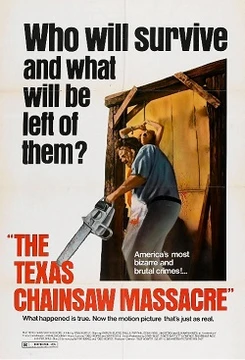
The Sawyer Family
Blood is thicker than water, and in this family, both are on the knife.

The Sawyer Family is the rotting, cannibalistic heart of The Texas Chainsaw Massacre franchise — a dysfunctional clan of isolated, poverty-stricken killers who dwell in a decaying farmhouse in the deep rural South. Across five decades of films, prequels, reboots, and a television series, they have functioned less as a single fixed unit and more as a generational archetype: a family bound by blood, hunger, and a shared madness that the outside world can neither save nor fully comprehend. They are the franchise's true antagonist, the reason the title carries its weight.
Their role extends beyond mere monster-of-the-week. The Sawyers embody the franchise's core anxieties — rural decay, the failure of institutions, the horror of the 'other' lurking behind a smile and a handout of meat. Every new film reinterprets who exactly belongs in the family, what keeps them together, and what the chainsaw symbolizes in that particular era of American fear.
- Affiliation
- Sawyer Family — rural Texas (in-story)
- First appears
- The Texas Chain Saw Massacre (1974)
- Key member
- Leatherface (the masked chainsaw killer)
- Family matriarch (original)
- The Grandmother (blind, drives the car)
- Setting
- Decaying farmhouse and surrounding woods, rural South
- Franchise span
- 1974 through present (films, TV, reboots)
Lore & Background
In the 1974 original, the Sawyer household is introduced through the eyes of a group of young urbanites who stumble into their world by accident. The Grandmother, blind and wheezing, drives the family's battered car and serves as the unit's matriarch and decision-maker. Pasty, the hunchbacked cook, moves through the kitchen with a quiet, unsettling efficiency. And then there is Leatherface — a towering, gaunt figure in a mask stitched from human skin, who wields a gasoline-choked chainsaw with the casual dread of a man mowing a lawn. The family's farmhouse is a cathedral of filth: animal carcasses hang in the kitchen, the walls sweat with grime, and the very air smells of rust and old blood. Their isolation is total; no sheriff, no neighbor, no church will intervene. They are, in the film's logic, a sovereign nation of three (or four) who answer to no one.
The family's cannibalism is not presented as spectacle alone but as domestic ritual. In the 1974 film, the act of preparing 'meat' is woven into the household's routine with a banality that is far more disturbing than any jump scare. The Grandmother's blind confidence, her insistence that the visitors are 'family' now, transforms the horror from a slasher set-piece into a slow, suffocating entrapment. The Sawyers do not hate their victims; they simply cannot imagine a world in which the people in their kitchen are not destined for the pot.
Later entries fracture and reassemble the family. The 2003 remake streamlines the roster, the 2006 prequel backstories Leatherface's origins in a childhood of abuse and institutional neglect, and the 2017 television series *Leatherface* explores the psychological architecture of the killer before the mask. The 2016 and 2023 reboots pass the bloodline to new generations, suggesting the Sawyer madness is not a single family's curse but a regional, almost ecological phenomenon — a sickness of the land itself that produces new carriers when the old ones are put down. What remains constant across every iteration is the farmhouse, the chainsaw, the skin mask, and the inescapable truth that in the deep South, the back road does not always lead home.
In Their Own Story
The screen of the old car flickers with static. The Grandmother's fingers drum the steering wheel, her milky eyes fixed on a road she cannot see. Behind the wheel, the engine coughs and dies in the humid dark, and the silence that follows is the kind that presses against your eardrums. Through the windshield, the farmhouse resolves from the tree line — a sagging rectangle of rot, its porch light the only warm color in a world of black and grey. A door opens. A shape stands in the doorway, too tall, too still, the mask catching the porch light in a way that makes the stitched eyes look almost wet. The Grandmother smiles. She always smiles. From the kitchen, the low, rhythmic *thunk-thunk-thunk* of a cleaver on a block. Pasty is preparing dinner. The visitors, still in the car, still in their seatbelts, still pretending this is a misunderstanding, watch the tall figure tilt its head. The chainsaw sits on the porch step, its pull-cord dangling like a tongue. The Grandmother taps the car window with one long, dirt-caked nail. 'Come in, children,' she says, and her voice is warm, and kind, and absolutely final. 'We've been expecting you. We've been expecting you for a very long time.'
Reader's Guide
The Sawyer Family's cultural life across the franchise maps directly onto America's shifting anxieties about rural space, institutional failure, and the body.
The 1974 original arrived in the long shadow of Vietnam and the Watergate era. The family's total self-sufficiency — no government, no law, no moral framework — read as a paranoid inversion of the social contract. The Grandmother's blind authority and Pasty's silent labor evoked a pre-industrial, almost feudal household. Audiences in 1974 saw in the farmhouse a place where the rules of the civilized world simply did not apply, and the horror was not the killing but the *normalcy* of it. The chainsaw, then, was not a weapon but a tool, as mundane as a kitchen knife.
The 2003 remake and 2006 prequel shifted the register toward psychological trauma and childhood abuse, reflecting the early-2000s slasher trend of giving monsters sympathetic backstories. Leatherface became a victim before he became a killer, and the family's cruelty was reframed as a cycle of inherited violence. This resonated with a post-9/11 audience preoccupied with the origins of extremism.
The 2016 and 2023 reboots, by contrast, strip away the sympathetic backstory almost entirely. The new Sawyers are not tragic; they are *ecological*. The franchise's final, most radical move is to suggest the family is less a bloodline than a *place* — a sickness of the dirt, the heat, the isolation. The chainsaw is no longer a tool or a weapon. It is the sound the land makes when it is hungry.
Did You Know?
- The 1974 original was directed by Tobe Hooper, who was in his mid-twenties and had previously worked in theater and low-budget television before the film made him an instant figure in horror cinema.
- Leatherface's iconic mask is constructed from stitched human skin, a detail that has become one of the most recognizable and imitated images in the entire horror genre.
- The 2017 Syfy television series 'Leatherface' was a prequel that explored the character's childhood and the psychological origins of his violence, expanding the family's lore well beyond what the films had established.
- The franchise has cycled through remakes, prequels, reboots, and a direct-to-video sequel, making the Sawyer Family one of the most repeatedly revisited antagonist units in horror film history.
More in Themes & Franchise History
Elsewhere in the The Texas Chainsaw Massacre universe
Spotted an error? Know more?
This is a living reference — every entry is fact-audited, and reader corrections feed straight into our audit queue. Suggest an edit · See this site's audit record