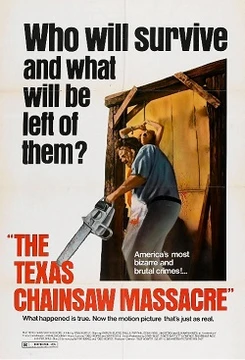
The Chainsaw as Symbol
One roar, one blade, and a nation of nightmares stitched into the sawdust.

The chainsaw is not merely a prop in The Texas Chainsaw Massacre—it is the franchise's beating heart, its visual thesis, and the single most recognizable object in American horror cinema. From the moment it roars to life in Tobe Hooper's 1974 debut, the saw functions as a symbol layered with meaning: industrial power turned feral, the rural South's defiance of urban modernity, and the grotesque inversion of a household tool into an instrument of annihilation. It belongs to Leatherface, yes, but it also belongs to the audience's collective memory of dread.
Across five decades of sequels, reboots, and the AMC television series, the chainsaw has been recontextualized, re-lit, and re-scored, yet its symbolic weight has never fully shifted. It remains the thing that makes a viewer's stomach drop before a single face is revealed. This entry traces that symbolic life, from the sawdust-choked fields of 1974 to the neon-lit reinterpretations of the 2020s.
- Role
- Central symbol and signature weapon of the franchise
- Primary wielder
- Leatherface
- First appears
- The Texas Chainsaw Massacre (1974)
- Director of origin
- Tobe Hooper
- Franchise medium
- Film and television
- Cultural status
- Iconic horror imagery; frequently cited in discussions of slasher cinema
- Symbolic associations
- Rural vs. urban, industrial violence, Southern otherness, domesticity corrupted
Lore & Background
In the 1974 original, the chainsaw arrives not as a surprise but as an inevitability. The film builds its dread through silence, through the creak of the family's rotting house, through the slow reveal of the butchery in the basement. When Leatherface finally lifts the saw and the engine coughs to life, the sound is almost domestic—a lawnmower, a hedge-trimmer, a neighbor's Saturday chore—before the blade makes contact and the domesticity shatters. That juxtaposition is the entire thesis of the franchise in one shot. The saw is what the countryside does to the city: it grinds you down to bone and calls it dinner.
The saw also encodes a specific American anxiety. In 1974, the Vietnam War was still bleeding, the energy crisis was tightening, and the South was a cultural 'other' to the Hollywood and New York establishments that funded and consumed the film. Leatherface, mute and masked, wields the saw as a kind of repressed masculine rage made literal. He does not speak because he does not need to; the saw speaks for him, and it speaks in a register that no urban audience can fully translate. The saw is the South's answer to the North's television sets and parking lots: you built your world on efficiency, and I will show you what efficiency looks like when it has teeth.
In the 2003 reboot and the 2022 AMC series, the chainsaw is re-lit with cleaner cinematography and more deliberate sound design, yet the symbolic grammar persists. The saw is still the thing that separates the 'family' from the world. It is their industry, their religion, their argument. When it stops, the family is merely a house full of old people. When it runs, they are a force of nature, and the audience is the meat on the hook.
In Their Own Story
The engine ticked cold in the dark of the barn, a sound like a heart deciding whether to beat. Dale could smell it—two-stroke oil and the sweet rot of the meat hooks above. He had heard it before, in the distance, a low thrum that meant the family was working. Tonight it was closer. Tonight it was in the yard.
He pressed his back against the wall of the house, the one with the porch light still burning yellow. The saw coughed. Coughed again. Then the long, tearing scream of the blade biting into the air, and the smell changed. It was no longer oil. It was iron. It was the particular copper tang that meant something had just been opened that should have stayed closed.
Dale did not run. Running was for people who still believed the saw was a tool. He simply stood there, in the yellow light, and listened to the engine idle, patient as a dog waiting for its master to open the gate. The saw was not angry. The saw was never angry. It was simply hungry, and it had been hungry a very long time, and tonight the gate was open.
Reader's Guide
The chainsaw in Tobe Hooper's 1974 film operates on a principle of deferred recognition. The audience sees the object before they understand it. It is a thing you can buy at a hardware store, something a farmer uses to cut firewood, and that ordinariness is the true horror. The saw does not need to be monstrous in design; it only needs to be pointed at you. This is the film's great insight, and it is why every subsequent entry in the franchise, from the 1986 sequel to the 2023 David Bruckner film, returns to the same visual grammar: the saw is introduced in context, in a workshop or a barn, before it is introduced as a threat.
The 2003 reboot, directed by Jonathan Mostow, leaned into the saw's spectacle, giving it longer chase sequences and more elaborate sound design. The AMC series of 2022, by contrast, treated the saw almost as a character with a temper, letting it idle and stall, making the audience wait. Each era reinterprets the symbol for its moment: 1974 saw it as the South's silent scream, 2003 as pure adrenaline, the 2020s as a slow-burn domestic menace. The blade never changes. What changes is what the audience fears it represents.
The sound design deserves particular attention. In the original, the saw's roar is mixed almost too loud, a physical assault on the theater speakers. In later entries, the sound is more controlled, more rhythmic, almost musical. The shift mirrors the franchise's own evolution from shock cinema to a more textured, atmospheric horror tradition. The saw is the same. The ear has changed.
Did You Know?
- The 1974 original was inspired in part by the real-life crimes of Ed Gein, a rural Wisconsin man whose use of body parts and household materials became a cultural touchstone for horror, though the film's 'family' of cann
- The chainsaw's sound in the 1974 film is mixed so prominently that it functions almost as a second character, often audible before the blade itself is visible on screen, creating a layer of dread separate from the visual
- The franchise has cycled through multiple reboots and continuations across five decades, yet the chainsaw remains the one element that every iteration preserves, treating it as non-negotiable to the story's identity.
- Leatherface is largely mute throughout the franchise, meaning the chainsaw's roar is, in many scenes, the only 'voice' he has, making the sound design a direct substitute for dialogue and emotional expression.
More in Themes & Franchise History
Elsewhere in the The Texas Chainsaw Massacre universe
Spotted an error? Know more?
This is a living reference — every entry is fact-audited, and reader corrections feed straight into our audit queue. Suggest an edit · See this site's audit record