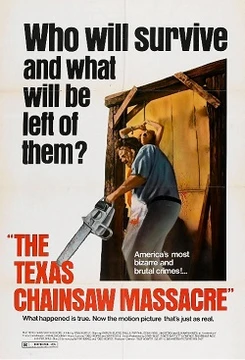
Texas Chainsaw 3D
A dusty Texas farmhouse, a masked butcher, and a family that never left.

Texas Chainsaw 3D (2013) is a horror film directed by John Luessenhop that attempts to rekindle the legacy of the original 1974 Texas Chainsaw Massacre by presenting a 'reimagining' rather than a direct sequel. Set in the dusty, sun-bleached backroads of rural Texas, the story follows a young woman who inherits her late grandmother's crumbling farmhouse and brings her small group of friends to help with the move—only to discover the property is still occupied by a deranged, insular family whose patriarch is the masked butcher known as Leatherface, here portrayed by Dan Yeager.
The film occupies a contested space in franchise history. Marketed heavily through its 3D presentation and its promise of a fresh entry in the saga, it was received with deep ambivalence by longtime fans who felt it neither honored the original's raw, improvisational energy nor committed to a bold new mythology. It stands as a case study in how a beloved horror property can be diluted when a studio prioritizes format and brand recognition over the specific cultural and aesthetic DNA that made the original terrifying.
- Director
- John Luessenhop
- Release year
- 2013
- Leatherface portrayed by
- Dan Yeager
- Protagonist
- Heather (Alex Rappaport)
- Setting
- Rural Texas, an inherited farmhouse
- Franchise role
- Soft reimagining / standalone entry
- Notable format
- Shot and released in 3D
Lore & Background
In the mythology of the Texas Chainsaw universe, the 'family' is less a bloodline than a cult of survival—a twisted kinship forged in the red dirt of the backcountry, where the law does not reach and the only currency is meat, silence, and the grinding of a chainsaw. Texas Chainsaw 3D transplants this family into a slightly more domesticated frame: an old farmhouse with a porch, a kitchen full of jars, and a grandfather who speaks in a slow, unhinged cadence. The grandmother presides over the household with a quiet, maternal menace, and Leatherface moves through the frames like a shadow with a blade, his mask a patchwork of human skin that has become, in this telling, almost a second face.
The film's central tension is not just survival-of-the-night horror but a collision between two kinds of Texas. Heather and her friends arrive with the clean, suburban assumptions of a city-dwelling young woman; the family inhabits a Texas that exists outside time, where the rules of property, hospitality, and personhood have been rewritten in blood. The farmhouse itself becomes a character—a mouth with a porch, a throat you can walk into, a place where the past refuses to be buried.
Fans who grew up on the 1974 original often note that the 3D entry captures the *look* of that world—dust, decay, the particular golden-brown light of a Texas afternoon—while missing its *sound*: the feral, half-improvised energy that made the original feel like a documentary gone wrong. The 3D film is more polished, more staged, and in doing so, trades the original's terrifying authenticity for a kind of haunted-postcard nostalgia.
In Their Own Story
The truck sputters to a stop on the gravel drive, and the dust hangs in the air like a held breath. Heather kills the engine and just stares at the farmhouse. It's smaller than she imagined, but the porch sag is the same one from the photograph her mother kept in a shoebox. Frank is already unloading boxes. Jack and Samantha are arguing about the GPS.
She steps inside. The kitchen smells of woodsmoke and something sweeter, something she can't name. A jar of pickled things sits on the counter, undisturbed. The screen door creaks. Through the gap she can see, across the yard, a figure in a burlap coat standing very still by the woodpile, watching. Not moving. Just watching.
The chainsaw hasn't started yet. But the silence is the worst part. The silence is the part that means it's about to.
Reader's Guide
The 1974 Texas Chainsaw Massacre was, in many ways, a film about the *failure of the road trip*—a group of young people who leave the city and enter a landscape where the social contract has simply evaporated. That theme of suburban innocence colliding with rural otherness is the franchise's gravitational center, and Texas Chainsaw 3D returns to it with a modern, 3D-filtered lens.
What makes the 3D entry interesting to film students is its *domestication* of the horror. The original's family lived in a derelict shack; the 3D film gives them a farmhouse with a working kitchen and a porch swing. The terror is no longer in the *absence* of civilization but in its *corruption*—the grandmother serves you a meal, the grandfather offers you a chair, and the mask is the only thing that doesn't pretend. This shift mirrors a broader trend in 2010s horror: the monster in the house, the family that's *almost* normal, the horror of the familiar made wrong.
Fans of the earlier sequels (Leatherface: Texas Chainsaw Massacre 2, The Texas Chainsaw Massacre: The Next Generation) will notice the 3D film largely abandons the more fantastical, slasher-logic plotting in favor of a contained, single-location siege. It's a return to the original's structure—small group, isolated space, one killer—while losing the original's documentary grit. The 3D format, ironically, draws the eye *into* the frame and makes the farmhouse feel more intimate, more claustrophobic, which is the one thing the film does better than its predecessors: it makes you feel like you're standing on that porch, watching the figure by the woodpile.
Did You Know?
- The 3D film was one of the first major horror releases to be shot natively in 3D, with the stereoscopic depth used to emphasize the claustrophobia of the farmhouse interiors and the looming scale of Leatherface in wide s
- Dan Yeager, who played Leatherface in the 3D film, later reprised the role in the 2022 Texas Chainsaw Massacre reboot, making him one of the few actors to carry the mask across two separate franchise timelines.
- The film's 'reimagining' approach meant it deliberately avoided references to the original 1974 cast or the specific backstory of the family, positioning itself as a parallel story in the same world rather than a direct
- The rural Texas setting in the 3D film leans heavily on the visual language of the 1974 original—dust, faded wood, the particular flat light of the plains—suggesting a conscious effort to evoke the aesthetic of Tobe Hoop
More in Themes & Franchise History
Elsewhere in the The Texas Chainsaw Massacre universe
Spotted an error? Know more?
This is a living reference — every entry is fact-audited, and reader corrections feed straight into our audit queue. Suggest an edit · See this site's audit record